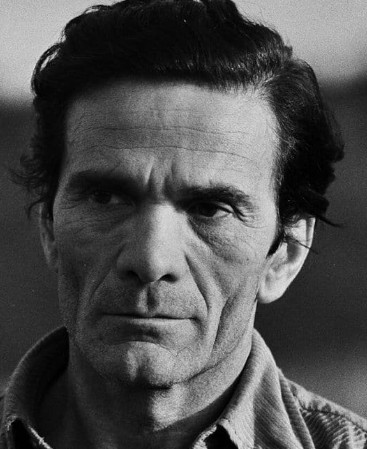
PASOLINI, Pier Paolo
|
|
|
The Day of My Death
In a city, Trieste or Undine
along an avenue bordered by linden trees
in spring when the leaves
change color
I will fall dead
under a burning noonday sun
my eyes closing upon
the sky and its splendor.
Beneath the mild green of the lindens
I will sink into the
black of my death
parting from the sun and the leaves.
Beautiful young boys
will run in the light
I will now have lost
streaming from their schools
curls on their brows.
I will still be young,
in a bright shirt,
my hair tender in the rain
falling on the bitter dust.
I will still be warm
and a child running on the
soft asphalt of the avenue
will come and rest his hand
on my crystal loins.
Song of Church Bells
Evening at twilight entwines
amidst fountains
and my village takes shelter
in reticent colors.
I recall from a far distance the humming
of frogs, the moon, the sad cries
of the crickets.
Rosario’s singing slowly diminishes
across the fields while
to the sounds of church bells I die.
Stranger, you need not fear
my genial dash across the plains:
I am the spirit of love
returned to my village from faraway.
Little Nocturnal Poems
I
It has no foundation, this emptiness
brought by the new season
submitted to an unknown force
where reason, assailed,
gives relief to animal senses
awakened in new spaces.
Here we feel ourselves somewhat
necessary, seized again
so that this wing, warm, enables
us to see the vanity in any sign
which would insist on our remaining unrecognized
and to see far off a true human time.
IV
Mysterious lightness
of the dead weight of what
is now life, candor
of a blemished heart…
Whose feelings are like lace
after midnight
when a prostitute,
mute, silent, returns home
It is truly there,
the wind of inner life
which never slackens,
and the monotonous variation
of feelings: now,
happy, who knows why,
(for nothing, or even more
like a prostitute
I come back from
a hopeless night of roaming)
burning gloriously
with life: prey to forces
now living, now spent
|
ma nazione vivente, ma nazione europea: e cosa sei? Terra di infanti, affamati, corrotti, governanti impiegati di agrari, prefetti codini, avvocatucci unti di brillantina e i piedi sporchi, funzionari liberali carogne come gli zii bigotti, una caserma, un seminario, una spiaggia libera, un casino! Milioni di piccoli borghesi come milioni di porci pascolano sospingendosi sotto gli illesi palazzotti, tra case coloniali scrostate ormai come chiese. Proprio perché tu sei esistita, ora non esisti, proprio perché fosti cosciente, sei incosciente. E solo perché sei cattolica, non puoi pensare che il tuo male è tutto male: colpa di ogni male.
Sprofonda in questo tuo bel mare, libera il mondo
|
feed gouging under the unharmed villas,
|
Poem for Ninetto I
Your place was at my side,
and you were proud of this.
But, sitting with your arm on the steering wheel
you said, “I can’t go on. I must stay here, alone.”
If you remain in this provincial village you’ll fall into a trap.
We all do. I don’t know how or when but you will.
The years that comprise a life vanish in an instant.
You are quiet, pensive. I know it is love
that is tearing us apart.
I have given you
all the power of my existence,
yet you are humble and proud, obeying a destiny
that wants you to remain impoverished. You don’t know
hat to do, whether to give in or not.
I can’t pretend your resistance
doesn’t cause me pain.
I can see the future. There is blood on the sand.
The Lament of the Excavator
I
It is only loving, only knowing that matters,
not
having
loved, not
having
known.
To live for a past love
makes for agony. The soul
doesn't grow any more.
Here, in the enchanted heat of the night
in its depth down here
along the bends of the river with its drowsy
visions of the city strewn with lights
echoing still with a thousand lives,
lacklove, mystery and misery of the senses
make me an enemy of the forms of the world,
which until yesterday were my reason for living.
Bored and weary, I return home,
through dark market places,
sad streets by river docks,
among shacks and warehouses mixed
with the last fields.
There, silence is deadly.
But down along the Viale Marconi,
at Trastevere station, the evening still seems sweet.
To their neighbourhoods, to their suburbs
the young return on light motorbikes --
in overalls and work pants
but spurred on by a festive excitement,
with a friend behind on the saddle,
laughing and dirty. The last customers
stand gossiping loudly
in the night, here and there, at tables
in almost-empty still brightly-lit bars.
Stupendous and miserable city,
you taught me what joyful ferocious men
learn as kids,
the little things in which the greatness
of life is discovered in peace,
how to be tough and ready
in the confusion of the streets,
addressing another man, without trembling,
not ashamed to watch money counted
with lazy fingers by sweaty delivery boys
against facades flashing by
in the eternal color of summer,
to defend myself, to offend,
to have the world before my eyes
and not just in my heart,
to understand that few know the passions
which I've lived through:
they are not brothers to me,
and yet they are true brothers
with passions of men who,
light-hearted, inconscient,
live entire experiences unknown to me.
Stupendous and miserable city,
which made me experience that unknown life
until I discovered what
in each of us
was the world.
A moon dying in the silence that lives on it
pales with a violent glow
which miserably, on the mute earth
with its beautiful boulevards and old lanes,
dazzles them without shedding light,
and a few hot cloud masses
reflect them over the world.
It is the most beautiful summer night.
Trastevere, smelling of straw
from old stables and half-empty wine bars,
isn't asleep yet.
The dark corners and peaceful walls
echo with enchanted noise.
Men and boys returning home
under festoons of lonely lights,
toward their alleys choked with darkness and garbage,
with that soft step
which struck my soul
when I really loved,
when I really longed to understand.
And now as then, they disappear, singing.
Mothers Ballad
I wonder what kind of mothers have you had.
If they could see you now at work
in a world they don’t know,
taken in an endless circle
of experiences so different from theirs,
what look would they have in their eyes?
If they were there, while you, conformists and baroques,
are writing your article
and you give it to editors who are used
to all kind of compromise, would they recognise you?
Coward mothers, with an ancient fear on their face,
which (the fear) is like a disease
that warps features with paleness,
obfuscates them, distances them from the heart,
and lock them in the old moral rejection.
Coward mothers, poor them, troubled from the idea
that their children will know cowardness
to ask for a work place, to be realistic,
to not offend priviliged souls,
to protect themselves from any pity.
Lousy mothers, who have learnt
with a child-humility
only one bare meaning about us,
with souls in a damned world
wich doesn’t give pain nor joy.
Lousy mothers, who didn’t have
for you a single word of love,
if not a meanly mute, beasty love
and in this love they raised you,
harmless to the real call of your heart.
Servile mothers, used for centuries
to bow their heads without love.
to transmit to their fetus the ancient, shameful secret
of contenting yourselves with the remains of the feast.
Servile mothers, who taught you
how the servant can be happy
hating who is, like him, in chains,
how he can be content and safe
cheating and doing what he doesn’t say.
Fierce mothers, focused on defending
the little that bourgeoises own,
the normality and the salary,
with the rage of the ones who take their revenge
or the ones who are under an absurd attack.
Fierce mothers who said you:
“Survive! Think about yourself!
Don’t have any pity or respect
for anybody, harbor in your chest
your vulture’s integrity!”
There they are, your coward, lousy, servile,
fierce, poor mothers!
They are not ashamed from the knowledge of you
being arrogant in your hate.
This is just a tears’ valley.
The world is yours in this way:
brothers in the opposite passions,
or opponent homelands,
that refuse being different and (refuse)
to answer to the savage pain of being humans.