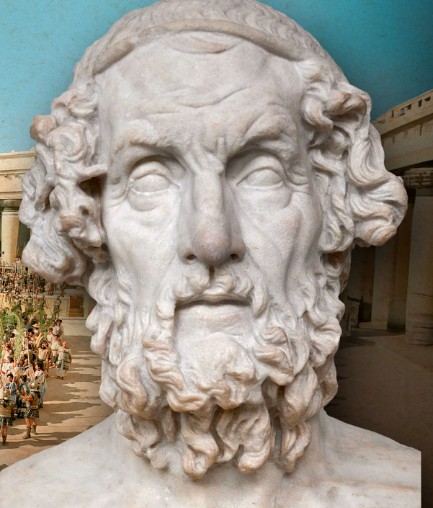
HOMERUS
Odyssey
Book I, lines 1–10
…..
Tell me, O Muse, of that ingenious hero who travelled far and wide
after he had sacked the famous town of Troy.
Many cities did he visit, and many were the nations with whose manners
and customs he was acquainted; moreover he suffered much by sea while
trying to save his own life and bring his men safely home;
but do what he might he could not save his men, for they perished
through their own sheer folly in eating the cattle of the Sun-god Helios;
so the god prevented them from ever reaching home.
Tell me, Muse, of these things, daughter of Jove,
and start where you will.
…..
Book V, lines 215–224
…..
Goddess,” answered Ulysses, “do not be angry with me.
I know very well that Penelope is nothing like
so tall or so beautiful as yourself.
She is only a woman, whereas you are an immortal.
Nevertheless, I want to get home,
and can think of nothing else.
If some god strikes me on the high seas, I will bear it;
I have had enough trouble already.
Let me see my home once more,
and then let death take me.”
…..
Book XI, lines 488-495
…..
Do not, therefore, take it amiss,” said I, “if I give you sorrowful news.”
No man in the world,” said he,
“is more blessed than you, Achilles, nor ever will be;
for when you were alive we Argives honoured you as a god,
and now that you are here you are a mighty prince among the dead.”
“Say not a word,” he answered, “in death’s favour;
I would rather be a paid servant in a poor man’s house
and be above ground, than king of kings among the dead.
…..
Book XII, lines 184–191
…..
Come here,” they sang, “renowned Ulysses,
honour to the Achaean name, and listen to our two voices.
No one ever sailed past us without staying
to hear the enchanting sweetness of our song—
and he who listens will go on his way not only charmed,
but wiser, for we know all the ills
that the Greeks and Trojans wrought in wide Troy,
and all that shall hereafter come to pass upon the earth.”
…..
Book XXII, lines 35-41
…..
“You yellow dogs,” he shouted, “you thought
I should never come back from Troy.
You have wasted my substance, have forced my women servants to lie with you,
and have wooed my wife while I was still alive,
though you little thought how soon I should return.
You have feared neither God nor man, and now you shall die.”
…..
Book XXXIII,
…..
Now from his breast into the eyes the ache
of longing mounted, and he wept at last,
his dear wife, clear and faithful, in his arms,
longed for as the sunwarmed earth is longed for by a swimmer
spent in rough water where his ship went down
under Poseidon's blows, gale winds and tons of sea.
Few men can keep alive through a big serf
to crawl, clotted with brine, on kindly beaches
in joy, in joy, knowing the abyss behind:
and so she too rejoiced, her gaze upon her husband,
her white arms round him pressed as though forever.
…..
Iliad
Book II
…..
Those who held the strong city of Mycenae, rich Corinth and Cleonae; Orneae, Araethyrea, and Licyon, where Adrastus reigned of old; Hyperesia, high Gonoessa, and Pellene; Aegium and all the coast-land round about Helice; these sent a hundred ships under the command of King Agamemnon, son of Atreus.
His force was far both finest and most numerous, and in their midst was the king himself, all glorious in his armour of gleaming bronze—foremost among the heroes, for he was the greatest king, and had most men under him.
.…..
Book III
…..
Marshalled together under their leaders, the Trojans advanced with cries and clamour, a clamour like birds, cranes in the sky, flying from winter’s storm and unending rain, flowing towards the streams of Ocean, bringing the clamour of death and destruction to Pygmy tribes, bringing evil and strife at the break of day. The Achaeans, however, breathing fury, firm in resolve to aid each other, came on in silence.
As when a Southerly veils the mountain-tops in mist, a mist the shepherds hate, where a man can see less than a stone’s throw ahead, but thieves hold it dearer than darkness, so thick clouds of dust rose under their feet as they sped over the plain.
And as they approached in their advance, godlike Paris stepped out from the Trojan ranks as their champion, a panther’s skin on his back, a sword and a bow slung over his shoulders; flourishing twin bronze-tipped spears he challenged the best of the Greeks to meet him, face to face, in single combat.
When Menelaus, beloved of Ares, saw him stride out from the host, he felt as the hungry lion does that finds the whole carcase of a wild goat, or an antlered stag, and tears it greedily, though nimble hounds and powerful huntsmen plague him: such was his pleasure when he saw godlike Paris,
…..
Book VI
…..
Dear husband," said she, "your valour will bring you to destruction; think on your infant son, and on my hapless self who ere long shall be your widow- for the Achaeans will set upon you in a body and kill you. It would be better for me, should I lose you, to lie dead and buried, for I shall have nothing left to comfort me when you are gone, save only sorrow. I have neither father nor mother now. Achilles slew my father when he sacked Thebe the goodly city of the Cilicians. He slew him, but did not for very shame despoil him; when he had burned him in his wondrous armour, he raised a barrow over his ashes and the mountain nymphs, daughters of aegis-bearing Jove, planted a grove of elms about his tomb. I had seven brothers in my father's house, but on the same day they all went within the house of Hades. Achilles killed them as they were with their sheep and cattle. My mother- her who had been queen of all the land under Mt. Placus- he brought hither with the spoil, and freed her for a great sum, but the archer- queen Diana took her in the house of your father. Nay- Hector- you who to me are father, mother, brother, and dear husband- have mercy upon me; stay here upon this wall; make not your child fatherless, and your wife a widow; as for the host, place them near the fig-tree, where the city can be best scaled, and the wall is weakest. Thrice have the bravest of them come thither and assailed it, under the two Ajaxes, Idomeneus, the sons of Atreus, and the brave son of Tydeus, either of their own bidding, or because some soothsayer had told them.
…..
Book XXII
…..
Hector looked up, saw him, started to tremble,
nerve gone, he could hold his ground no longer,
he left the gates behind and away he fled in fear —
and Achilles went for him, fast, sure of his speed
as the wild mountain hawk, the quickest thing on wings,
launching smoothly, swooping down on a cringing dove,
and then she flits out from under, the hawk screaming
over the quarry, plunging over and over, his fury
driving him down at her to tear his kill
…..
Book XXIII
Nor yet the pile, where dead Patroclus lies,
Smokes, nor as yet the sullen flames arise;
But, fast beside, Achilles stood in prayer,
Invoked the gods whose spirit moves the air,
And victims promised, and libations cast,
To gentle Zephyr and the Boreal blast:
He call’d the aerial powers, along the skies
To breathe, and whisper to the fires to rise.
The winged Iris heard the hero’s call,
And instant hasten’d to their airy hall,
Where in old Zephyr’s open courts on high,
Sat all the blustering brethren of the sky.
…..
(Alexander POPE)